
The Unsung Hero of Construction: A Deep Dive into Concrete and Its Types
Introduction
Concrete. It's the silent foundation of our modern world. From the towering skyscrapers to the humble sidewalk beneath your feet, this material is indispensable. But what exactly is concrete, and why has it become the most popular building material in contemporary construction?
For homeowners and builders alike, understanding the different types of concrete is crucial for ensuring the strength, durability, and cost-effectiveness of any project, especially here in Sri Lanka. This guide breaks down the composition, common grades, and primary applications of the two main concrete types used in home construction.
What Exactly is Concrete?
Concrete is a synthetic composite material created by mixing four key components in specific proportions:
Cement: The binding agent (often referred to as a "fine aggregate" along with sand).
Sand: The fine aggregate.
Metal/Gravel (Kalu Gal): Various sizes of crushed stone, known as "coarse aggregate."
Water: Activates the cement through a chemical process called hydration.
In its initial, wet state, the concrete mixture is a viscous, semi-solid that takes the shape of whatever mould or formwork it is placed into. Over a precise curing period, it transforms into an incredibly strong, solid material. Its low cost, ease of use, and the ability to enhance its properties with additives have solidified its role as the building material of choice globally.
The Two Main Types of Concrete for Home Construction
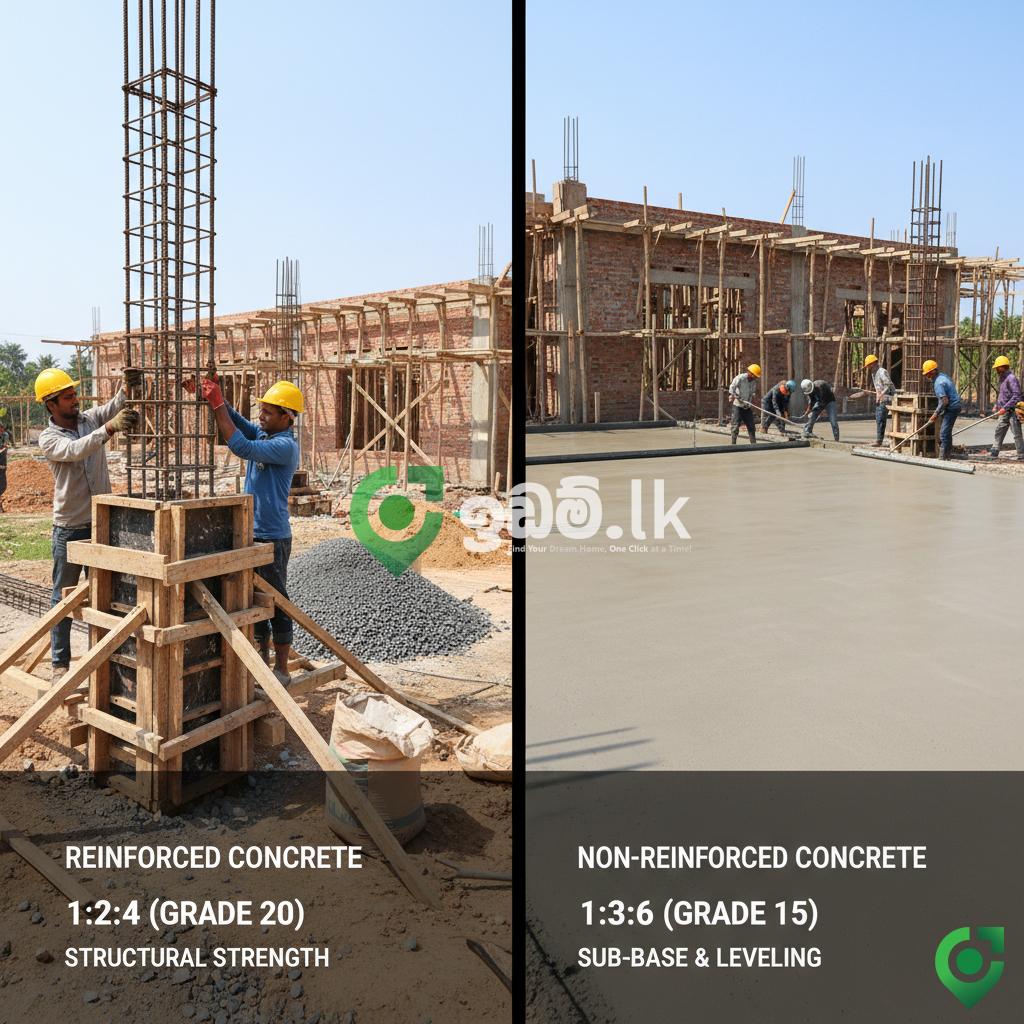
When building a house, concrete is broadly divided into two categories based on whether or not it incorporates steel reinforcement:
1. Reinforced Concrete (RC)
Why Reinforcement is Essential:
Plain concrete has outstanding compressive strength (it resists crushing forces). However, it is a brittle material with very poor tensile strength (it fails easily when pulled apart or subjected to bending forces). To compensate for this weakness, high-yield steel bars (rebar) are embedded in the concrete. The steel absorbs the tensile stress, creating a composite material that is strong in both compression and tension.
Common Mix Ratio & Grade:
For Reinforced Concrete, the common mix ratio uses:
Cement
Sand
20mm (3/4 inch) Metal
High Yield Steel Reinforcement (Rebar)
The most widely used structural mix ratio is:
This mix is typically categorized as Grade 20 (M20 ). This grading signifies that after 28 days of curing, the concrete will achieve a minimum compressive strength of 20 N/ mm^2 . The full specification is often written as 1:2:4(20) , with the number in parentheses indicating the maximum size of the metal aggregate used (20mm).
Where Reinforced Concrete is Used (High-Stress Applications):
Reinforced concrete is critical for all structural elements that bear significant load or are subjected to bending and pulling forces:
Concrete Column Bases (Footings/Foundations)
Concrete Columns
Concrete Beams (Thalanda)
Concrete Lintels (Above doors and windows)
Concrete Slabs (Floors and Roofs)
2. Non-Reinforced Concrete (Plain Concrete)
Key Difference:
As the name suggests, this type of concrete does not utilize steel rebar. It is used in applications where the concrete will be subjected primarily to compressive forces and minimal or zero tensile stress.
Common Mix Ratio & Grade:
Non-Reinforced Concrete typically uses:
Cement
Sand
A wider range of Metal sizes: $20\text{mm}$ (3/4 inch) up to $37.5\text{mm}$ (1 1/2 inch)
The widely adopted mix ratio is:
This mix is often classified as Grade 15 (M15 ). This means the concrete will achieve a minimum compressive strength of 15 N / mm}^2 after 28 days. The full notation is written as 1:3:6(20 to 37.5) , reflecting the varying size of the coarse aggregate.
Where Non-Reinforced Concrete is Used (Ground Contact & Base Layers):
Plain concrete is typically used for non-structural, levelling, or filling purposes:
Blinding Concrete (Screed): A lean layer of concrete applied over excavated earth before laying the foundation's column bases or strip foundations. It provides a clean, level, and stable working surface.
Ground Floor Concrete (Floor Concrete/Slab-on-Grade)
Mass concrete filling
Critical Advice for Your Construction Project
The core strength of any concrete structure lies in using the correct ingredient ratios.
The Danger of Incorrect Mix Ratios:
Using the wrong ratio—such as adding too little aggregate—can lead to several costly problems:
Reduced Structural Strength: The concrete structure's overall strength will be compromised, potentially leading to failure.
Honeycombing (Ciduru): Poorly mixed or proportioned concrete can result in visible voids or honeycombs within the structure. These voids significantly weaken the structure's integrity and durability.
Increased Cost: Using less metal (aggregate) means using more costly cement and sand to fill the volume, increasing the overall project expense.
The Technical Goal:
A correctly proportioned concrete mix is engineered so that the fine aggregates (cement and sand) perfectly fill all the gaps between the tightly packed coarse aggregates (metal), resulting in a dense, void-free, and maximally strong solid structure.
Build Strong. Build Smart.
Choosing the right type of concrete and, crucially, using the correct Cement : Sand : Metal ratios is the single most important decision for the long-term health of your building. Always consult with a qualified structural engineer or contractor to ensure the Grade 20 and Grade 15 mixes are applied accurately to every part of your construction, guaranteeing a strong foundation for your future home.
- idam.lk - Your Partner in Building Excellence -